
Inside the Bright Yellow Bus: How the Danfo Mirrors the Chaotic Rhythms of Nigeria’s Sociopolitical landscape
By Funmilola Jesse
I remember my first and perhaps only time in a danfo. I must have been six years old. I can’t recall where my mother and I were going, or why we even needed to take that trip, but what I do remember has stayed with me like a scent trapped in memory.
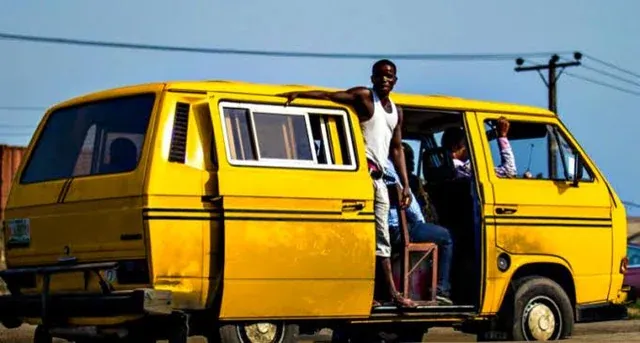
The air inside the bus was thick with the pungent smell of after-work body odour. somewhere between exhaustion, poverty, and a quiet frustration with a government that had long stopped pretending to care. Toddlers wailed, too young to understand that the heat and discomfort tormenting them were only a foreshadowing of the life their parents were already living, and the one they, too, would most likely inherit. Beads of sweat rolled down foreheads,some from the heat, some from the desperate sprint it took to catch the moving bus. Street vendors shoved their hands and their hopes through the open, windowless frame, pushing goods into our laps and our faces. Safety wasn’t even an afterthought; it was a luxury no one expected.
This wasn’t transportation. It was survival of the fittest. And then there were the sleepers, grown adults somehow dozing off in the middle of that sensory assault. I remember staring at them, confused at how anyone could surrender to rest in a place so loud, so hot, so suffocating.
But maybe that was the point. Maybe their lives outside the bus were so exhausting, so relentlessly demanding, that the danfo chaotic as it was offered the closest thing to stillness they would feel all day. Or perhaps, for them, this wasn’t chaos at all. Maybe this was their normal. Maybe the rocking of the bus, the conductor’s shouting, the vendors tapping on metal, the engine coughing like it needed prayer, maybe all of it formed a rhythm their bodies had learned to trust. A rhythm predictable enough to sleep in. In a country that had long abandoned predictability, the danfo was the one place where people could count on the chaos to stay consistent.
long before I understood Nigeria, I had already ridden inside its metaphor. And the older I get, the clearer the parallels become. Every danfo journey contains the essential ingredients of the Nigerian state: power, chaos, resignation, ingenuity, and the fragile hope that somehow, despite everything, we will reach our destination.
THE DRIVER: POWER WITHOUT TRANSPARENCY
The danfo driver is perhaps the most accurate depiction of Nigerian leadership:
almost invisible, rarely questioned, and steering the entire vehicle without consultation or explanation. You don’t know his qualifications, you don’t know his logic, and you definitely don’t know why he chooses to brake sharply or swerve violently at the exact moment you loosen your grip on the metal bar. You only know that your life is in his hands, and that’s a reality Nigerians understand far too well.
Every pothole he dodges is a policy decision.
Every reckless overtake is a budget adjustment.
Every unannounced stop is a shift in national direction.
And like citizens, passengers simply adjust, complain under their breath, or silently endure it. Because where are they going to go? There is no alternative route, no modern system waiting to absorb the overflow. Just like the state, the danfo leaves its people no choice but adaptation.
THE CONDUCTOR: THE VOICE OF THE STATE
If the driver is the government, then the conductor is the state’s spokesperson
loud, insistent, persuasive, and perpetually improvising.
He is the Minister of Information, Internal Affairs, and Revenue Collection rolled into one sweaty, agile human being who hangs halfway out of the bus while shouting the itinerary of your fate:
“Oshodi! Oshodi! Enter with your change!”
His voice is the first government announcement you hear that day.
His fare calculations are inflation, deregulation, and subsidy removal all happening in real time.
His promises of change are as hollow as campaign speeches.
Yet, in some strange way, he is also the glue that holds everything together.
He mediates disputes, keeps the peace, enforces order, chases passengers, collects money, performs customer service, and provides entertainment all while clinging to a moving bus with one hand.
Only in Nigeria is a conductor both a civil servant and a stunt performer.
THE PASSENGERS: THE PEOPLE WHO KEEP THE COUNTRY RUNNING
The rest of us, ordinary Nigerians, show up as passengers.
We squeeze ourselves into tight spaces, adjusting our bodies and expectations.
We know the risk, we expect the discomfort, but we board anyway because survival requires movement.
Inside that yellow box, class distinctions blur.
A market woman, a banker in white shirt, a student with a backpack, a cleaner, a man too tired to stay awake, they all become equal under the dictatorship of the danfo.
Passengers negotiate their dignity in tiny, subtle ways:
a bag shifted, a shoulder turned, a complaint swallowed.
We survive through courtesy and quiet endurance.
The danfo forces everyone into a communal reality:
your discomfort becomes someone’s elbow,
someone’s sweat becomes your perfume,
your fear becomes everyone’s collective tension when the driver swerves too hard.
It is the purest representation of Nigerian social life, individual struggle held together by communal discomfort.
THE BREAKDOWN: A NATIONAL SYMBOL
And then, inevitably, the bus breaks down.
Not always immediately, but eventually the engine emits a dry cough, the driver mutters a prayer, and the danfo rolls to a slow, shameful stop by the roadside. Passengers sigh. Vendors circle like vultures. The conductor jumps down and begins a frantic inspection that involves slapping the bus in ways that feel more spiritual than mechanical.
It is a ritual every Nigerian recognizes.
The breakdown is not an interruption.
It is part of the journey.
Just like our national crises: fuel scarcity, economic collapse, protests, inflation
we treat breakdowns as expected rather than exceptional.
And the most Nigerian thing of all?
After several minutes of banging, adjusting, tightening, and muttered invocations, the bus sputters back to life.
Not fully repaired.
Just… functional enough.
A perfect metaphor for a state that refuses to collapse fully,
refuses to grow properly,
and instead survives through patchwork resilience.