
Lagos rolls out industrial policy, targets Africa’s manufacturing crown
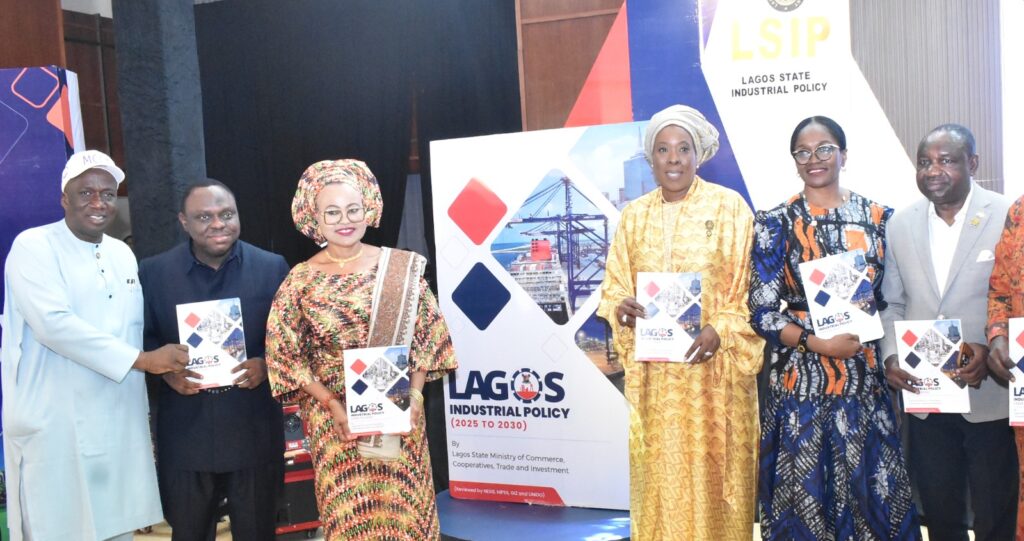
Lagos State Government has unveiled its Industrial Policy 2025-2023designed to transform the state’s industrial sector, attract local and foreign direct investment into priority sectors, and strengthen institutional coordination, translating the policy commitments into real outcomes for the people of the State.
Lagos State Governor, Babajide Sanwo-Olu led eminent members of the diplomatic corps, senior government officials, captains of industries and others at the event held in Lagos on Thursday,
Speaking at the ceremony, through the Secretary to the State Government, Barrister ‘Bimbola Salu-Hundeyin, Governor Sanwo-Olu stated that the new industrial policy is both urgent and compelling for a state that is long been the commercial heartbeat of Nigeria, and a vital gateway to West Africa.
His words: “The global industrial landscape is changing rapidly. Supply chains are evolving, technology is redefining production systems, and competitiveness is increasingly determined by efficiency, by innovation, and by resilience, with scale alone no longer sufficient to secure the markets of the future.
“To remain at the forefront, Lagos must do more than adapt. We must lead. This policy is our considered response to that imperative. It is designed to address longstanding structural challenges, to unlock new growth opportunities, and to ensure that our industrial sector becomes a powerful engine for inclusive economic development across this State.”
According to the Governor, the policy is firmly anchored in the broader development vision, aligning seamlessly with the T.H.E.M.E.S Development Agenda, particularly in advancing a 21st‑century economy, in strengthening infrastructure, and in fostering sustainable growth. It is equally aligned with the Lagos State Development Plan 2052, which envisions Lagos as a globally competitive megacity driven by productivity, by innovation, and by industrial excellence.
“At its core, the policy is built on clear and strategic pillars; prioritising industrial infrastructure development; committing to regulatory reform and the ease of doing business; strengthening access to finance and investment promotion; advancing skills development and workforce readiness; and promoting innovation, technology adoption, and sustainability.
“From these pillars flow clear and measurable deliverables. We will expand and optimise industrial clusters and estates across the State. We will improve the efficiency of our port system, as is being done through the Lekki Deep Sea Port, and of our broader transport networks, to reduce the cost of moving goods. We will support small and medium‑scale manufacturers to scale their operations and to integrate into both regional and global value chains,” he said.
Sanwo-Olu stressed that by prioritising key sectors, and by supporting Nigeria’s commitments under the African Continental Free Trade Area, AfCFTA, the Lagos Industrial Policy acts as an implementation engine that localises national ambitions, accelerates industrial productivity, and positions Lagos as a strategic gateway for Nigeria’s industrial expansion and global competitiveness.
Representative of the Minister of State/Director, Industrial Inspectorate Department, Federal Ministry of Industry, Trade and Investment, affirmed that the Lagos State Industrial Policy 2025 to 2030 is closely aligned with Nigeria’s National Industrial Policy, translating federal priorities into targeted, State‑level actions that reflect the economic realities and the competitive advantages of Lagos.
“By focusing on a competitive and productive industrial base, Lagos is providing a practical model that supports the Federal Government’s objectives of job creation and poverty alleviation through industrial growth. The Federal Ministry of Industry, Trade and Investment views Lagos State as a critical partner. We recognize that for Nigeria to achieve true industrialisation, we must our attention on strengthening infrastructure and others as reflected in the LSIP,” he said.
Commissioner for Commerce, Cooperatives, Trade and Investment, Folashade Ambrose-Medebem, described the Industrial Policy 2025-2030 as more than a policy, but a covenant between the government and more than twenty‑five million Lagosians whose ambition powers this city every single day.
“To the captains of industry in this hall, the State has done its part. Bring your capital, your capacity, and your conviction, and Lagos will reward each of them. To our partners in the financial sector, we say this. Lagos is, today and for the foreseeable horizon, the highest‑yielding industrial portfolio on this continent. Price it accordingly. Allocate to it accordingly.
“Underwrite it accordingly. To the academic community, we say this. Build with us the talent pipelines that this policy will demand, for an industrial strategy without skilled hands is a strategy on paper alone, and we did not labour over this policy to leave it on paper. To our friends in the development sector, we say this.
“Lagos is ready, more than ready, to convert technical assistance into measurable industrial output, and to do so on timelines that will repay your patience. To our brothers and sisters in the diaspora, we say this. The home you carry in your hearts is now ready for the investment you carry in your hands. Come home to invest. Come home to build. Come home to Lagos.”