
Shettima Questions Atiku’s Economic Credentials, Criticises Subsidy Proposal

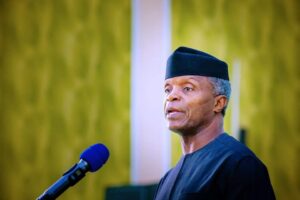
Vice-President Kashim Shettima has questioned the capacity of former Vice-President Atiku Abubakar to manage Nigeria’s modern economy, citing his educational background and opposition to the removal of petrol subsidy.
Shettima made the remarks on Monday while speaking at the 32nd Nigerian Economic Summit in Abuja, where he criticised Atiku’s proposal to restore petrol subsidy if elected president in 2027.
Atiku, the presidential candidate of the African Democratic Congress (ADC), has advocated policies different from those of President Bola Tinubu’s administration.
Describing the proposal as a step backwards, Shettima said it would amount to reversing the government’s economic reforms for political convenience.
“One of the leading presidential candidates (Atiku) is advocating a return to the subsidy scheme. He wants us to backslide into primitivity for political convenience,” the Vice-President said.
Shettima also questioned Atiku’s qualifications to manage a modern economy, referring to his training at the Kano School of Hygiene.
“I dare to put forward that his skill set… he was trained in sanitation at the Kano School of Hygiene. So he doesn’t have the skill set to govern a modern economy. That’s a painful truth,” he said.
The Vice-President further made remarks about Atiku’s understanding of infectious diseases, arguing that Nigerians should consider the candidates’ competence before making their choices in the 2027 elections.
Shettima defended Tinubu’s decision to remove petrol subsidy, saying the President took the measure because he understood the country’s economic realities.
“The President took those painful decisions because he understands the dynamics,” he said.
He also praised Anambra State Governor Chukwuma Soludo, describing him as one of his admired figures in Nigerian politics despite their different political affiliations.
Shettima’s comments come as political parties and their leading figures intensify exchanges ahead of the 2027 general elections, with economic management and the future of petrol subsidy emerging as key issues in the political debate.